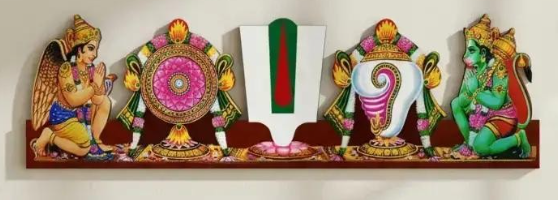
Thirumalai · 11th century
Ananthalwar
The man of courage who laid the garden of the Lord. Disciple of Sri Ramanuja, gardener of Srinivasa, father-in-law of the Lord of the Hill.
1053 CE
Born at Siruputtur, Cittirai star, Bhāradvāja gotra
Āṇ Piḷḷai
The only man who would climb the forested Hill
Pacchaikarpuram
Camphor on the chin, from a crowbar’s blow
Āḍi Pūram
The magizha tree still receives the Lord’s honour

Taniyan
The verse the Lord Himself recited
अखिलात्मगुणावासम् अज्ञानतिमिरापहम् । आश्रितानां सुशरणं वन्देऽनन्तार्य देशिकम् ॥
Akhilātmaguṇāvāsam ajñānatimirāpaham Āśritānāṃ susaraṇaṃ vande Anantāryadeśikam
I bow to Acharya Anantharya, dwelling of every noble quality, who dispels the darkness of ignorance, the sure refuge of those who take shelter in him.
First taniyan — recited by Srinivasa as Madhurakavidāsa
All six taniyans, dasashloki, and kattiyamश्रीमद् रामानुजाचार्य श्रीपादाम्भोरुहद्वयम् । सदुत्तमाङ्गसन्धार्यम् अनन्तार्यमहं भजे ॥
Śrīmad Rāmānujācārya śrīpadāmboruhadvayam Sadhūttamāṅgasandhāryam Anantāryam ahaṃ bhaje
I worship Anantharya, who is equal to the two lotus feet of Sri Ramanuja, and whom the good bear upon their heads.
Second taniyan — recited by Srinivasa as Madhurakavidāsa

The twin aṃśa
Ramanuja for the word. Ananthalvan for the work.
As Nara and Nārāyaṇa took twin births at Badrinath, Ādiśeṣa is said to have come twice in that century: Ramanuja at Sriperumbudur, to preach; Ananthan at Siruputtur, to practise. One churned the Śrībhāṣya. The other dug a lake on a Hill no one would climb.
When the Acharya walked the finished garden — vakula, pāṭala, pannaga, śenbaga, bees in the bunches — he said, “O Anantharya, having nursed thee, I now reap the fruit.”
Līlās
Stories still told on the Hill

The call
Āṇ Piḷḷai — the man of courage
When Ramanuja asked who would climb the malaria-haunted forest of Tirumala to lay a flower garden, only Anantharya rose.
Read the story
Pacchaikarpuram
The crowbar and the chin
A young brahmachari helped a pregnant woman carry mud. Ananthalvan struck him with a crowbar — and found the Lord bleeding in the sanctum.
Read the story
Madhurakavidāsa
The command of the Acharya
When the Lord summoned him mid-garland, Ananthalvan finished the flowers first. He would rather be banished than disobey Ramanuja.
Read the story
Tiruvandaadi
Ananthazhvar and Bhoothatthazhvar
A male elephant in musth pulls a bamboo shoot, dips it in a honeycomb, and extends it to its mate. Ananthazhvar heard Ramanuja’s discourse on Dvayam in that paasuram.
Read the story
Vaḻi-tirunāmam
Malaiyil Veṅkaṭavarkku māmaṉār vāḻiye Alarmelmangai tiruvukku appaṉār vāḻiye
Glory to him who is father-in-law of the Lord of the Hill. Glory to him who is father of Alarmelmanga.
He tied Alarmelmanga to a champaka for spoiling the nandavanam. By morning she was his daughter, and Srinivasa his son-in-law. On the eighth day of Purattasi Brahmotsavam the Lord still wears the father-in-law’s silk.
Works
What he wrote

Seven stabakas · Sanskrit
Śrī Veṅkaṭācala Itihāsamālā
The garland of historical tales of the Hill of Venkata. Not a chronicle from origins to the writer’s day, but a record of the settlement of the shrine in the century of Ramanuja (c. 1050–1150): the Śaiva–Vaiṣṇava contest, the identity of the deity and of Svāmi Puṣkariṇī, and the arrangements ordered through Yādava Rāja. Edited for the TTD by S. Krishnaswami Aiyangar in 1937 from a rare Telugu edition.

Four verses · Sanskrit
Rāmānuja Catuślokī
Four verses on the glory of Ramanuja, and on the four places dear to him — Srirangam, the Tirumala Hills, Kanchi, and Melkote. Composed by the disciple who would not climb down from ācārya-pāratantrya even when the Lord Himself tested it.

Four verses · Sanskrit
Godā Catuślokī
A work of art in praise of Andal — depth of thought, warmth of feeling, glow of imagery. Andal pines for Srinivasa and sends cloud, rain, cuckoo, and Kāma as messengers. Ananthalvan, Ādiśeṣa to her Bhūmi, wrote as one who had searched her tank for turmeric.

Recitation · Sanskrit and Tamil
Taniyans, Dasashloki, Kattiyam
Six Sanskrit taniyans, including the two Srinivasa Himself recited as Madhurakavidāsa. Ten mangala shlokas by his son Varadacharya. The Thirumanjana Kattiyam — Sanskrit invocation and three Tamil pasurams — still recited at his sacred bath.

Still on the Hill
The magizha tree receives the Lord every Āḍi Pūram
He breathed his last in the garden he had dug. Srinivasa still comes in the evening of Andal’s birthday, and honours the tree as if the gardener had not gone.
Living legacy